
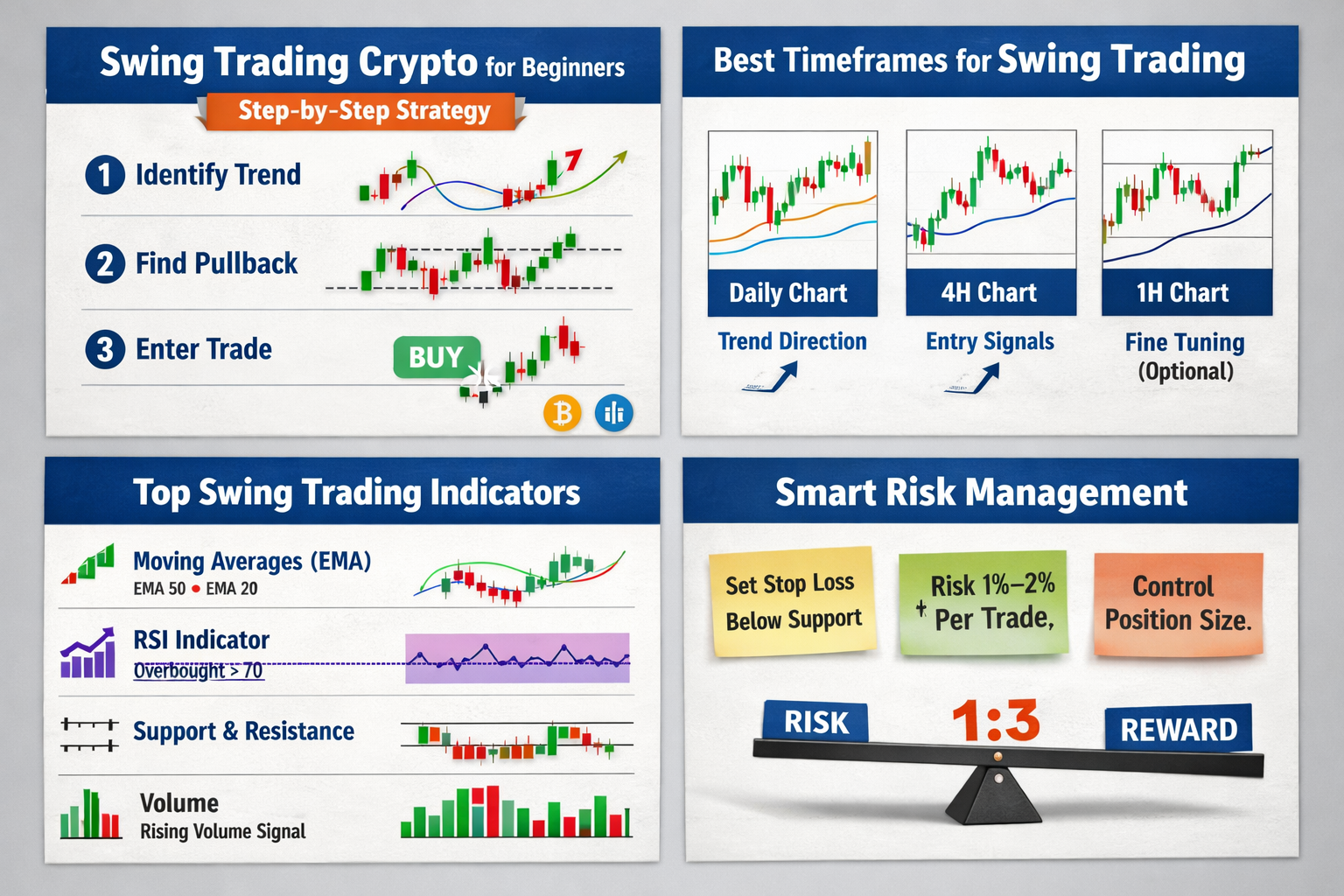
We’ve all been there: you buy a coin, and suddenly it drops. But instead of panic-selling, swing trading teaches you to stay patient, manage risk, and aim for profit when the price recovers. Swing trading is one of the best strategies for beginners because it gives you more time to think, plan, and trade without pressure—unlike fast trading styles that force quick decisions. And it’s not just for newbies… even experienced traders use swing trading to catch bigger moves to gain massive profits.
This article dives you into, how to build a consistent swing trading approach: how to pick setups, manage risk, and plan entries/exits.
The goal: trade less, trade better, and protect your capital.
What is Swing Trading Crypto?
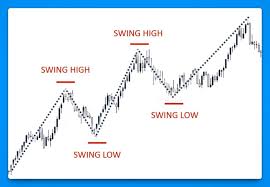
Swing trading means holding a position for a few days to a few weeks to capture a larger price move — a “swing.” You use chart patterns, trend direction, and a few indicators to enter on pullbacks and exit near logical targets. Unlike scalping, you’re not glued to the screen; unlike investing, your time horizon is short-to-medium. Its basically short time trading to gain optimal profits without risk of losing Crypto Coins.
Benefits of Swing Trading in Crypto
-
Lower time commitment than day trading — check charts a few times a day.
-
Bigger moves per trade than scalping — one clean swing can pay for many small trades.
-
Works well in crypto because volatility creates repeatable swings.
-
Easier learning curve for beginners when you use simple rules.
- Less Screen Time–
Swing Trading vs Day Trading vs Investing
-
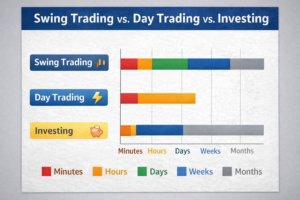
Day trading = same-day trades, high volume, high stress.
-
Investing = months–years, focus on fundamentals.
-
Swing trading = days–weeks, focus on technicals & risk control.
Best Timeframes & Chart Setup
-
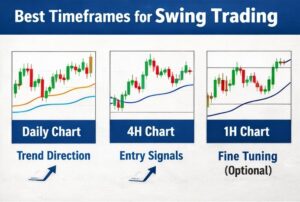
Daily chart (1D): Determine overall trend (bullish/bearish/sideways).
-
4-hour chart (4H): Primary timeframe for swing entries.
-
1-hour (1H): Optional for precise entry timing and confirmations.
Typical setup: use the daily to confirm trend, the 4H for a pullback entry, and the 1H to fine-tune your stop or limit order.
Top Indicators That Actually Help in Swing Trading
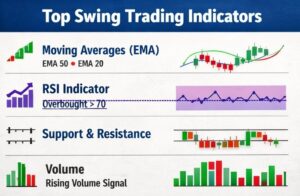
You don’t need dozens of indicators. Keep it to 2–3 reliable tools:
-
EMA (20 or 50): It really helps define trend and dynamic support/resistance.
-
RSI (14): Indicates overbought/oversold and bullish/bearish momentum.
-
Volume: Confirms strength of a move — rising volume + price move = more trustworthy.
-
Support & Resistance zones: Price behaves predictably at these areas.
Use indicators to confirm what price and structure already show — not to contradict price action.
Step-by-Step Swing Crypto Trading Strategy
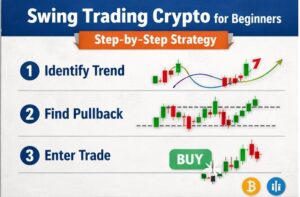
Follow this checklist for each potential trade:
1. Identify the Trend (Daily)
-
Bullish trend: higher highs & higher lows; prefer long trades.
-
Bearish trend: lower highs & lower lows; prefer shorts (if you trade futures).
2. Find a Pullback (4H)- Wait for price to pull back into a support zone: moving average, previous swing low, or horizontal support.
3. Confirm with Indicators
-
RSI near 30–45 on a bullish pullback (shows space to bounce).
-
Price near EMA20/50 or a clear support zone.
-
Volume shrinking during pullback and increasing on the bounce is a good sign.
4. Enter the Trade
-
Enter when a clear bullish reversal appears: bullish engulfing candle, strong wick rejection, or a confirmed break above a short-term resistance on 4H/1H.
5. Place Stop Loss
-
Conservative: just below the bullish reversal candle or below the support zone.
-
Aggressive: below the previous swing low.
-
Position size to risk 1% (or max 2%) of account on the trade.
6. Set Targets & Manage Trade
-
Primary target: next logical resistance (previous swing high).
-
Use a 1:2 or 1:3 risk-to-reward plan for realistic profitability.
-
Consider taking partial profits (e.g., 50%) at the first target and trailing the rest.
7. Exit Rules
-
Exit if price closes below your stop on the 4H chart.
-
Trail stops above higher lows once trade moves in your favor.
How swing traders use EMA 20/50: Price above EMA 20 & EMA 50 → Bullish trend Price below EMA 20 & EMA 50 → Bearish trend Price touches EMA and bounces → Good swing entry signalHow swing traders use RSI (14): Buy during pullback when RSI comes near 30–45 Take profit when RSI goes near 65–75 (depends on trend)
Choosing Coins to Swing Trade
Prioritize:
| Coin | Symbol | Why It’s Good | Best Timeframes | Key Indicators to Use |
|---|---|---|---|---|
| Bitcoin | BTC | Highest liquidity, smoother swings, major trend clarity | Daily (D1), 4H | EMA (20/50), RSI (14), Volume |
| Ethereum | ETH | Strong volume, good trend behavior | D1, 4H | EMA (20/50), MACD, RSI |
| Binance Coin | BNB | Stable moves, consistent structure | D1, 4H | EMA (20), Support/Resistance |
| Solana | SOL | More volatility for larger swing targets | 4H, 1D | RSI, EMA, Volume spikes |
| Cardano | ADA | Predictable pullbacks + support zones | D1, 4H | EMA (21), RSI, Trendlines |
| XRP | XRP | Rangeable + clear reaction levels | 4H, 1D | Support/Resistance, RSI |
| Polygon | MATIC | Decent volume + trading interest | 4H, 1D | EMA (20/50), Volume |
| Litecoin | LTC | Reasonable trend moves, good for learning | D1, 4H | Moving Averages, RSI |
| Dogecoin | DOGE | High volume + hype swings (higher risk) | 4H, Daily | EMA, RSI, MACD |
| Polkadot | DOT | Strong swings + clear structure | 4H, Daily | EMA (20), RSI |
-
High liquidity & volume (top 30–50 coins are best for most beginners).
-
Coins with clear chart structure and reliable swings (BTC, ETH, BNB, SOL, etc.).
-
Avoid tiny low-volume altcoins unless you understand their idiosyncrasies.
Risk Management: The Non-Negotiable Part
-
Risk per trade: 1%–2% of account.
-
Max drawdown rule: stop trading or reduce size if you lose X% in a week (set your own X).
-
No revenge trading: accept losing streaks and follow rules.
-
Use position sizing calculator to calculate quantity based on risk and stop distance.
Tools & Platforms for Swing Trading Crypto
-
Use reputable exchanges for spot or margin: high liquidity and good order execution.
-
Charting: TradingView or exchange charts with 4H/1D timeframes.
-
Alerts: set price alerts so you don’t watch charts all day.
-
Journal: keep a simple spreadsheet with entry/exit, reason, outcome — learn from it.
Common Beginner Mistakes & How to Avoid Them
-
Chasing pumps: wait for clear setups, don’t buy at the top.
-
No stop loss: always use one.
-
Overleveraging: leverage amplifies losses; avoid until experienced.
-
Overtrading: stick to high-probability setups, not every move.
Example Trade with Bitcoin
-
Trend: BTC in a clear uptrend on daily.
-
Pullback: price retraces to EMA50 on 4H; RSI ~38.
-
Entry: bullish engulfing candle on 4H.
-
Stop: 2% below entry (placed below support).
-
Target: next swing high (aim for 1:2 R:R).
This structured approach removes guesswork and helps you manage emotions.
Frequently Asked Questions
Q: How long do I hold swing trades?
A: Typically from 2 days up to a few weeks—depends on the setup and market.
Q: Do I need leverage to swing trade?
A: No. Leverage increases risk; beginners should trade spot or low leverage only.
Q: How many trades per week?
A: Quality > quantity. 1–5 well-planned trades per week is common.
Q: Can swing trading work in bear markets?
A: Yes—by trading short opportunities (if you can short) or by trading pullbacks within downtrends with tight risk management.
Final Thoughts
Treat swing trading is short time trading with huge profits margin with less risk. It can be easily plan, risk-manage, execute, and review. Discipline and consistency beat “brilliant guesses.” Keep rules simple, avoid emotional trading, and use the checklist above to build good habits.
Disclaimer- The information provided in this article is for general educational purposes only and does not constitute investment, financial, legal, or tax advice. Cryptocurrency markets are highly volatile and trading carries a high level of risk. Past performance is not a guarantee of future results. You are solely responsible for your trading decisions, and you should only invest money you can afford to lose.





How are you?
A really good blog and me back again.